

 | Battleship. This Page Is Planned For Merger With Otherships. | | ||||||||||||||||||||||||||||||||||||||||||||||||||||||||||||||||||||||||||||||||||||||||||||||||||||||||||||||||||||||||||||||||||||||||||
|---|---|---|---|---|---|---|---|---|---|---|---|---|---|---|---|---|---|---|---|---|---|---|---|---|---|---|---|---|---|---|---|---|---|---|---|---|---|---|---|---|---|---|---|---|---|---|---|---|---|---|---|---|---|---|---|---|---|---|---|---|---|---|---|---|---|---|---|---|---|---|---|---|---|---|---|---|---|---|---|---|---|---|---|---|---|---|---|---|---|---|---|---|---|---|---|---|---|---|---|---|---|---|---|---|---|---|---|---|---|---|---|---|---|---|---|---|---|---|---|---|---|---|---|---|---|---|---|---|---|---|---|---|---|---|---|---|---|---|---|---|
The "Lucrehulk-Class Battleship" was the primary capital ship of the Trade Federation's Trade Defense Force. Most Lucrehulks were modified from enormous cargo haulers. Upgra
NOTE: The UCG does NOT consider the Lucrehulk-Class to be a battleship, since the design is a modified cargo ship and the Confederation Of Independent Systems is not a legal authority. Characteristics At nearly 2 miles in diameter these enormous vessels resemble a donut-shape missing a section of its circumference and with a central sphere containing the ship's bridge and reactor assemblies. The forward holds of the craft held two mammoth docking bays on either side lined with forward docking "claws." These gigantic cargo vessels had been built for many years by the Trade Federation to haul cargo between planets and were an important asset to their enterprise. Housed in the stern of the hull were the main reactors each connected to one of the three main engines as well as to secondary engines and each other. The central sphere housed its own reactor/power generator assemblies. Lining the equatorial bands in batteries of three were quad turbolaser cannons capable of rotating inwards when not in use. Their limited coverage of the hull made the early battleships vulnerable, and made them rely more on the massive number of starfighters carried to defend the ships against enemy starfighters. This was later rectified along with armor and shields too strong for starfighters which become apparent at the Battle of Naboo; Battleships had less trouble with weak spots as they were augmented with gun batteries and much stronger shielding. Batteries of long guns and heavy guns complemented the additional quad turbolaser batteries added to the Lucrehulk superstructure when the war erupted. Each ship was also now so powerful due to the increased amount of power devoted to offensive and defensive systems that a whole task force of destroyers were needed just to bring down its shields. History Origins When the Trade Federation began creating its militry the Executive Board realized the need for large cruisers to transport their weapons across the galaxy, battleships to defend against starfighter attacks, and flagships for controlling their vast legions of battle droids. Reluctant to spend the money necessry to construct and purchase a fleet of military vessels they began modifying their existing Lucrehulk-Class freighters into warships, using a substantial fleet of the ships to enforce their blockade of Naboo led by the flagship Saak'ak. The most important vessel in the Trade Federation's blockade was the Droid Control Ship. When the rest of the blockade dispersed after Naboo was successfully occupied the Neimoidians left a Droid Control Ship in orbit to coordinate their forces; Her destrution resulted in the deactivation of the Droid Army. At the wars close the Republic put disbandment of the Federation's militry as part of the peace. The Federation pretended to comply by apparently disassembling most of its battleships only to transform their centrispheres into detachable Core Ships; These were used to carry legions of battle droids throughout the Clone Wars transporting militry equipment and troops to countless worlds and engaging Republic fleets in combat. During the wars, the Lucrehulk-Class received a massive upgrade in terms of firepower, with the addition of hundreds of long guns, quad guns, and heavy guns dotting the surface of both the core ship and the surrounding cargo arms. They along with the other capital ships of the Confederate Navy also proudly wore the colors and insignia of the Confederacy. A few dozen participated in the attack on Coruscant towards the end of the war. Some of these vessels that had been acquired by one means or another were used to try to destroy Outbound Flight. Chiss Commander MITTH'RAW'NIRUODO (commonly called THRAWN) destroyed all but one of them. Legacy Some militarized Lucrehulks remained in operation being untilized by various cost-conscience factions; A few were sold to the Corporate Sector or to wealthy merchants while some were used by reble forces. The FORTRESSA served as a starfighter carrier, carrying a complement of hundreds of T-65 X-wing starfighters and participated in an assault on the first Forgotten Weapon (she was destroyed by a superlaser). Despite the Lucrehulk-Class' obvious deficiencies as a warship many could be found in service even as the UGC began actively annexing the Rakatan Galaxy. Strategic Implications The Lucrehulk-Class per se is not especially impressive; In an 8 on 1 battle between "rogue" Palpatinian forces and an REF Spacy VEROCHA-Class frigate, the Lucrehulks wer utterly devastated; With the VEROCHA sustained heavy damage and had to eventually spend 2 years in a dockyard, the Lucrehulks were utterly annihilated, with even their fighters (top of the line Royal TIE Interceptors, equipped with FTL drives that "should have" allowed them to escape) completed destroyed. The VEROCHA sustained 50% fighter fleet loss, and no permanent casualties. In short militrily the Lucrehulk is NO match for the UGC, and little match for the Rakatan designs. One assessment bluntly put it "These battleships are crap. I wouldn't sign off on them for acceptance into the auxiliary fleet." However industrially speaking it's a potential threat; First it demonstrates how easily a civilian cargo ship can be converted to militry duties as a gun- and fighter-platform. More importantly the blueprints for the Lucrehulk is everything BUT a secret; The Neimoidians released the blueprints far and wide in the hopes others would rise up and using their ships return them to their "rightful" place. Thus numbers are a concern; The UGC has no idea how many of these ships are out there and neither does anyone else. There is known to be at least three abandoned fleets totaling over 1,000 ships collecting dust and dents. There may be even more that were stolen from the anchorages that no one really knows about. Pirates are fond of the design since it's easy to upgrade the firepower compared to some designs and the cargo bays provide more than enough space for hundreds of fighters and shuttles; Over 2,000 large shuttles were carried in the original configuration and nearly as many robot fighters as well. One would be very hard pressed to find a pirate fleet with so many members let alone a single ship though the Atorian Fessors are capable of this (they have over a dozen of these ships but even the GIB isn't aware of this since the Fessors don't think of them as real ships but rather prizes to eventually be sold). At the moment the Lucrehulk-Class isn't causing the UGC any particular concern but like a metaphorical bad dog that lives down the street they watch the equally metaphorical fence "just in case." 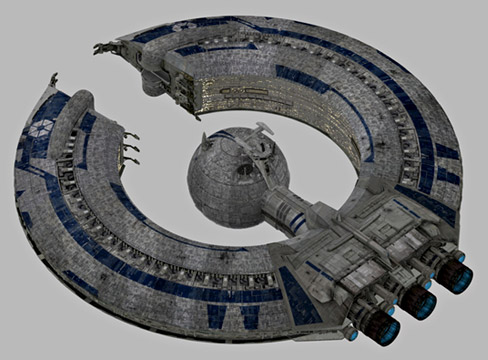 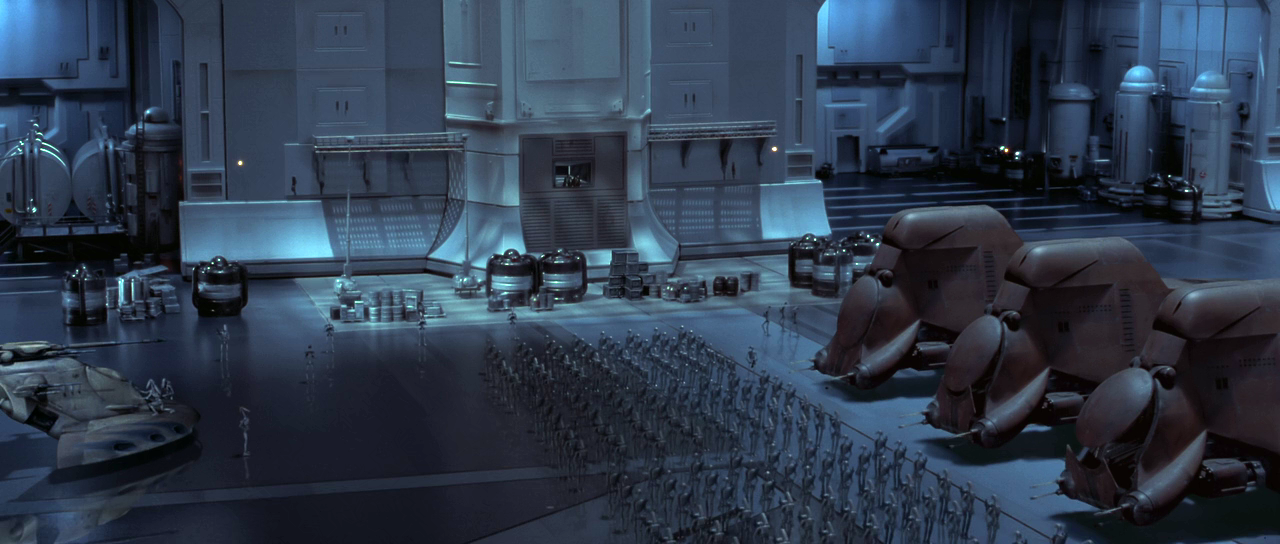  A common modification is to add levels within the hanger bays to increase capacity. This is especially common with fighter carriers. Three Quad Turbolaser Batteries On A Trade Federation Battleship. |  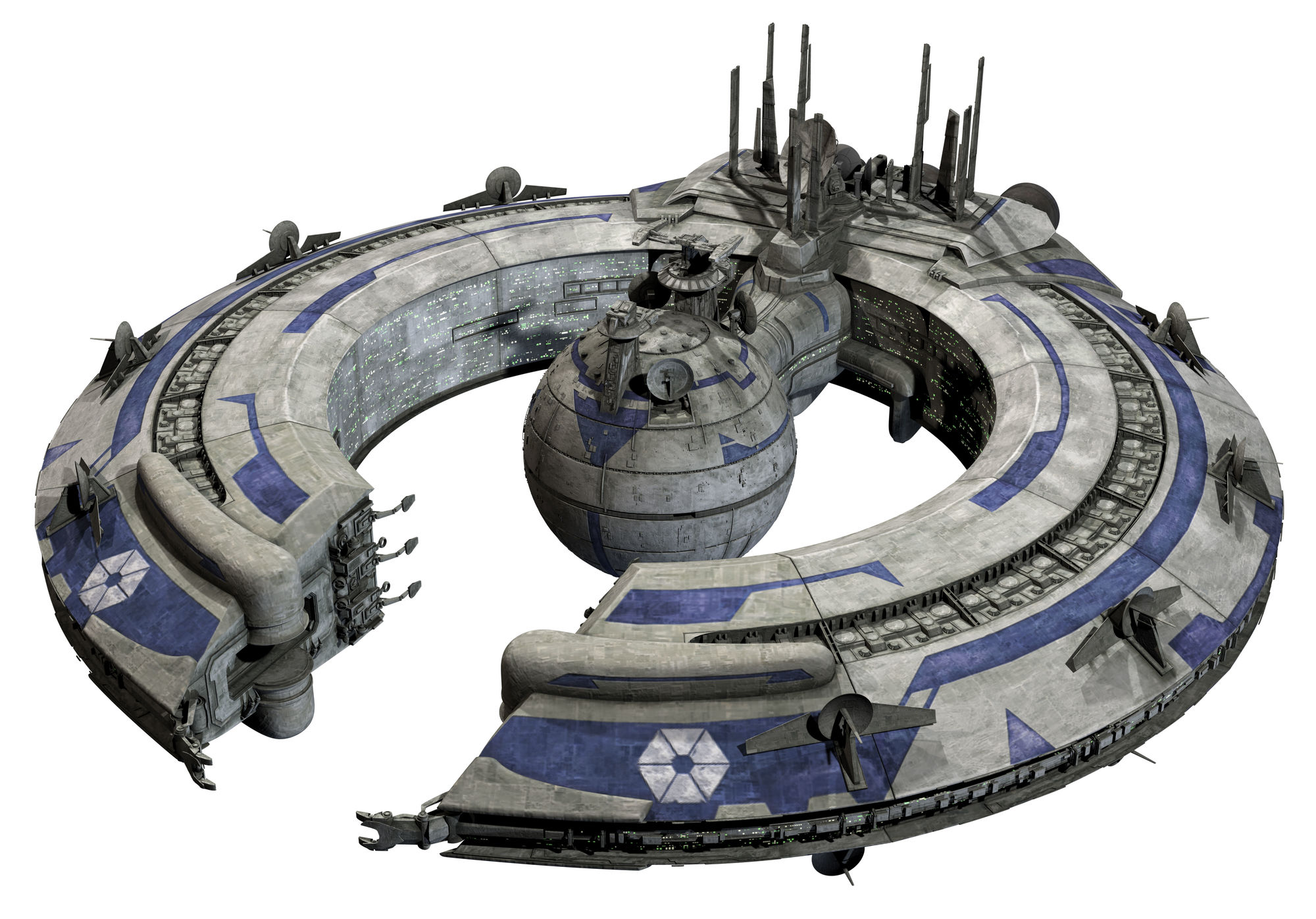 Core Ship.
Characteristics While fully capable spacecraft in their own right, the core ships were also able to reattach themselves to the outer ring hull of a Lucrehulk battleship and thus could resume their role as command cores. Thanks to their modular design, the spherical vessels could also be attached to a number of other Federation ship-designs, like cruisers, destroyers, tankers and container vessels. Dimensions The hierarchical arrangement of living quarters on a core ship resembled that of Neimoidian hives. The command bridges, executive suites and treasuries were located in the core ship's upper pole and towers. Lower levels were for junior managers, publicists and droid storage, and on at least some variants, much of the hull above the ship's equator served as a single vast hangar bay and flight deck. The lowest levels were given over to engineering areas and conference rooms, areas habitually shunned by high-ranking Trade Federation officials, who preferred to use droids to perform the demeaning and difficult responsibilities of dealing with outsiders or complex equipment. Propulsion Systems Core ships were designed to be capable of planetary landing, and equipped with massive repulsorlift suspensor units installed on their ventral section. In addition to these repulsorlift units, a ventral ion-thruster allowed for rapid take-off and escape from orbit. The core ship was also equipped with numerous landing legs, though the landing gear required repulsorlift assistance to support the hull in launch posture for any length of time. Offensive And Defensive Systems The basic type of core ship was a transport equipped only with point-defense laser cannons, designed to carry supplies around the galaxy. It had a sensor array at the top of its command tower that was similar in style to the sensor globes on the later Star Destroyer models. History
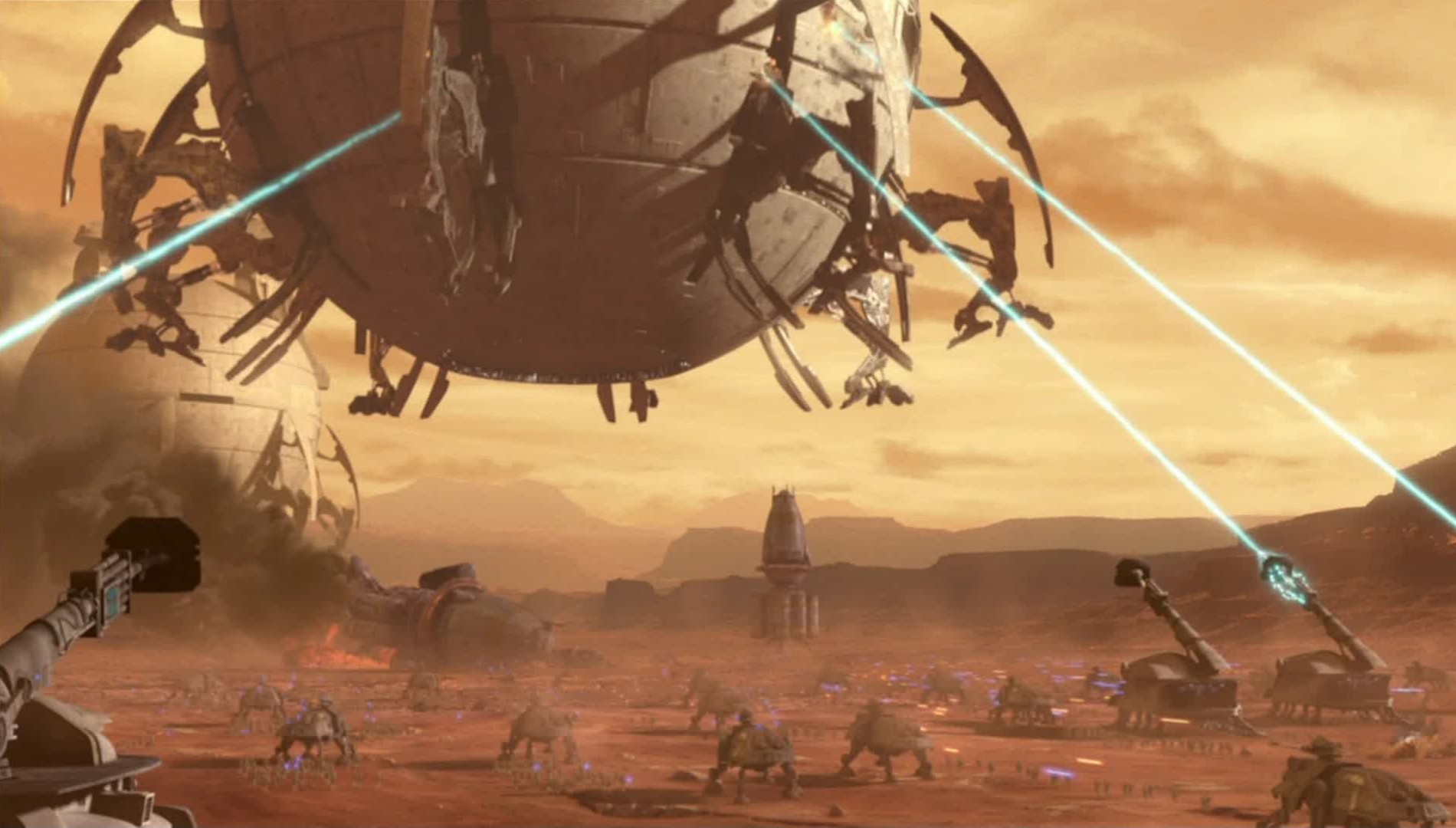
However, after the Invasion of Naboo, the Galactic Republic ordered the Trade Federation to disband its military forces. The crafty Trade Federation pretended to comply with this command by apparently disassembling most of its battleships, only to transform their centrispheres into Lucrehulk-class core ships. During the Battle of Geonosis, core ships successfully withdrew legions of battle droids from the planet's foundries in the face of the Republic assault, and during the Clone Wars, they transported military equipment and troops to countless worlds. During the battle, some core ships were brought down by Republic SPHA-T walkers. Towards the end of the Battle of Geonosis, a squad of Republic Commandos was able to infiltrate a disabled core ship and retrieve its launch codes. This allowed the Republic to prevent any more Confederacy of Independent Systems (CIS) ships from leaving the planet. During the Clone Wars, core ships underwent upgrades and modifications which led to a variety of internal and external configurations. Some of these were combat-capable variants, destroyers equipped with heavy weapons and droid starfighter swarms that could match the Republic's medium capital ships. In 21 BBY, the Separatist force deployed to secure Spaarti Creations on Cartao consisted of a core ship equipped with three C-9979 landing craft and around five thousand battle droids. Later on in the Clone Wars, a ship of this type, the Gahenna, was involved in an orbital duel above Honoghr and subsequently crashed on the planet, while two more participated in the Battle of Rendili, where they proved an equal match for two ACCLAMATOR-class assault ships. When a third ACCLAMATOR and five DREADNAUGHT-class cruisers of the Rendili Home Defense Fleet had their firepower added to the battle, the two were destroyed. The core ship Unlimited Projection was modified for long-term planetary deployment as a semi-permanent surface base on Utapau as the headquarters of General Grievous. Another core ship was left derelict on Geonosis during the Galactic Civil War. Following the end of the Clone Wars, the few remaining Lucrehulk battleships and core ships were sold to the Corporate Sector and to wealthy merchants. Auxiliary Craft. C-9979 Landing Craft | The C-9979 landing craft was a heavy transport starship used by the Trade Federation and later the Confederacy of Independent Systems chosen by the Armaments Committee and manuf 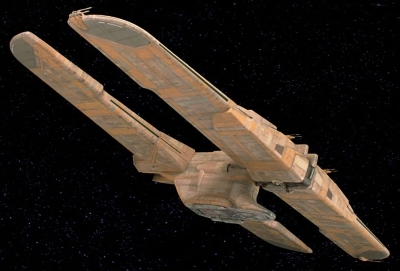 actured by Haor Chall Engineering Corporation, controlled by a central computer. They were heavily armed multi-vehicle and troop transport and landing craft utilized to deploy invasion forces to planets they intended to occupy manned by a small crew of droids in the topside control center. actured by Haor Chall Engineering Corporation, controlled by a central computer. They were heavily armed multi-vehicle and troop transport and landing craft utilized to deploy invasion forces to planets they intended to occupy manned by a small crew of droids in the topside control center.The entirety of a C-9979's internal volume was dedicated to vehicle and trooper storage save the wingtips which housed the tensor field generators and anti-gravity stabilizers. Hundreds of MTTs, AATs, and PACs were stored in special garages on the tensor-field supported wings while a few were kept in battle-ready positions behind the main deployment doors. Upon landing on a designated landing zone special perimeter field sensors on the main doors scanned the surrounding area to detect land mines or other potential hazards to the troop contingent. After giving the all clear the doors opened allowing the drop ramp to be deployed as the first combat-ready units exited the craft while the repulsor tracks lining the staging garages were activated guiding the vehicles from their storage to a staging area directly above the main gate. From the staging area specialized transport clamps lowered the vehicles to the exit tunnel while they powered their repulsors to exit the landing craft and begin their operations. Due to this complex procedure, the deployment of a full C-9979 contingent could take up to 45 minutes. The Trade Federation used many of these landing craft to deploy their Droid Army, including Multi-Troop Transports. As part of Separatist efforts to recruit planets to their side the Federation routinely sent representatives backed up by battalions of droids in C-9979's. They were also deployed to engage smaller elements of anti-Separatist factions. They were 688 feet 11½ inches, 1,213 feet 11 inches abeam, had a clearance of 80 feet 4½ inches and a maximum atmospheric speed 365 MPH with a Class 2 hyperdrive. Only two hulls are known to exist, neither in a condition to be used. Multi-Troop Transport (MTT) The Multi-Troop Transport (MTT) was a heavy repulsorlift vehicle designed and manufactured by Baktoid Armor Workshop from a modified cargo pod and used by the Confe 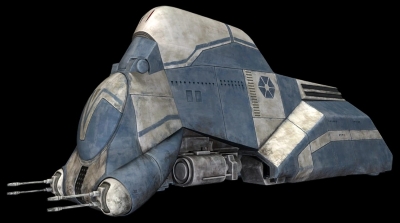 deracy of Independent Systems to transport B1-Series battle droids and Droids during the Clone Wars. The craft was reminiscent of a jungle animal with its reactor and main engines in the aft and could carry a company of 112 battle droids equipped with their standard blaster rifles. The original Baktoid design for the MTT called for an open staging chamber but Baktoid's eccentric designers had the unusual job of making a transport that had to convey droids not living beings and devised a system that could load folded battle droids onto a giant deployment rack that extended out from the face of the MTT allowing the droids more than doubling the troop capacity; The folded droids hung from the racks to be deployed directly into combat if needed. The MTT's face was reinforced and studded with case-hardened metal alloy studs and was designed to smash through enemy walls to reach its destination. The MTT's control room was staffed by an OOM pilot battle droid and a droid gunner/engineer. It was armed with a quartet of 17kv anti-personnel blaster cannons twin-mounted in two ball turrets, thus the MTT was almost unstoppable but after early action it became clear that the MTT's deployed too slowly. Later upgrade models designated the Heavy Multi-Troop Transport (HMTT) deployed soldiers in standing and battle-ready position allowing for immediate deployment of droids efficiently and reducing vulnerability. The MTT was armed with twin blaster cannons as an obvious counterpart to the Platoon Attack Craft which served a similar function. The MTT's weapons allowed it to deploy its B1-Series battle droids on the front line whereas the PAC was used to drop off troops and leave the battle. The MTT's first deployment was during the Invasion of Naboo in the year 32 BBY. They were landed on the far side of the planet and attacked the capital city. Following the destruction of the Droid Control Ship, all elements of the Trade Federation Droid Army on Naboo shut down. They were also utilized elsewhere to deploy super battle droids. deracy of Independent Systems to transport B1-Series battle droids and Droids during the Clone Wars. The craft was reminiscent of a jungle animal with its reactor and main engines in the aft and could carry a company of 112 battle droids equipped with their standard blaster rifles. The original Baktoid design for the MTT called for an open staging chamber but Baktoid's eccentric designers had the unusual job of making a transport that had to convey droids not living beings and devised a system that could load folded battle droids onto a giant deployment rack that extended out from the face of the MTT allowing the droids more than doubling the troop capacity; The folded droids hung from the racks to be deployed directly into combat if needed. The MTT's face was reinforced and studded with case-hardened metal alloy studs and was designed to smash through enemy walls to reach its destination. The MTT's control room was staffed by an OOM pilot battle droid and a droid gunner/engineer. It was armed with a quartet of 17kv anti-personnel blaster cannons twin-mounted in two ball turrets, thus the MTT was almost unstoppable but after early action it became clear that the MTT's deployed too slowly. Later upgrade models designated the Heavy Multi-Troop Transport (HMTT) deployed soldiers in standing and battle-ready position allowing for immediate deployment of droids efficiently and reducing vulnerability. The MTT was armed with twin blaster cannons as an obvious counterpart to the Platoon Attack Craft which served a similar function. The MTT's weapons allowed it to deploy its B1-Series battle droids on the front line whereas the PAC was used to drop off troops and leave the battle. The MTT's first deployment was during the Invasion of Naboo in the year 32 BBY. They were landed on the far side of the planet and attacked the capital city. Following the destruction of the Droid Control Ship, all elements of the Trade Federation Droid Army on Naboo shut down. They were also utilized elsewhere to deploy super battle droids.Platoon Attack Craft (PAC) The Platoon Attack Craft (PAC) was a repulsorsled personnel carrier used by the Trade Federation to transport B1-Series battle droids. The Federation developed its Plat  oon Attack Craft after the success of the deployment racks installed within their Multi-Troop Transports, retrofitting a series of commercial repulsorlift sleds with the racks and re-designated the vessels as Platoon Attack Crafts. The craft's drive unit was similarly adapted from a civilian cargo sled. The PAC carried no weaponry or heavy armor and had to rely on AATs and battle droids for protection, but did carry forward flood lights for use at night according to surviving artwork. They were deployed behind the protection of ground armor in secure conditions or within occupied territory. Although the MTT offered greater protection the troop carrier was faster and more agile. The troop carrier was piloted by two battle droid pilots and carried 112 droids forming a single company of two platoons. oon Attack Craft after the success of the deployment racks installed within their Multi-Troop Transports, retrofitting a series of commercial repulsorlift sleds with the racks and re-designated the vessels as Platoon Attack Crafts. The craft's drive unit was similarly adapted from a civilian cargo sled. The PAC carried no weaponry or heavy armor and had to rely on AATs and battle droids for protection, but did carry forward flood lights for use at night according to surviving artwork. They were deployed behind the protection of ground armor in secure conditions or within occupied territory. Although the MTT offered greater protection the troop carrier was faster and more agile. The troop carrier was piloted by two battle droid pilots and carried 112 droids forming a single company of two platoons.PACs were brought to battle with MTTs and AATs in C-9979 landing craft. Troop carriers were pledged by the Federation to the Confederacy of Independent Systems transporting battle droids from the planet's underground droid factories for Separatist forces. After the wars ended the few troop carriers that survived the conflict were converted into civilian cargo sleds. Combined Strategic Analysis None of these were worth the trouble of creating. The least ridiculous of them was the Platoon Attack Craft, since a PAC fitted with reentry shields might be capable of inserting a B-1's quickly, but even this was a highly dubious advantage since B-1's were fitted with force fields anyways, and these would have been sufficient to allow them to insert on their own. The A C-9979 could insert a large number, but the cost/benefit analysis consistently proves the craft was not an efficient use of resources. 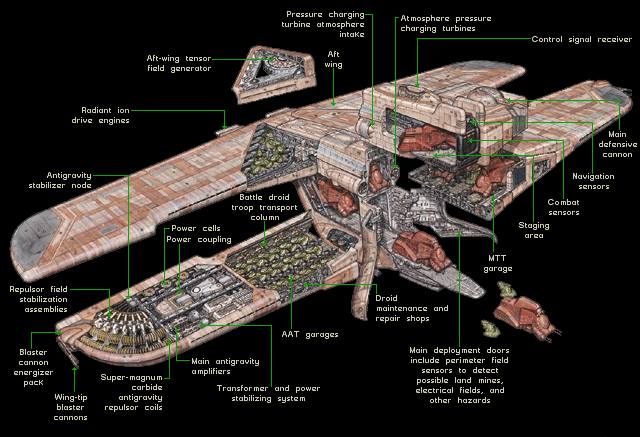  | ||||||||||||||||||||||||||||||||||||||||||||||||||||||||||||||||||||||||||||||||||||||||||||||||||||||||||||||||||||||||||||||||||||||||||