

 | | ||||||||||||||||||||||||
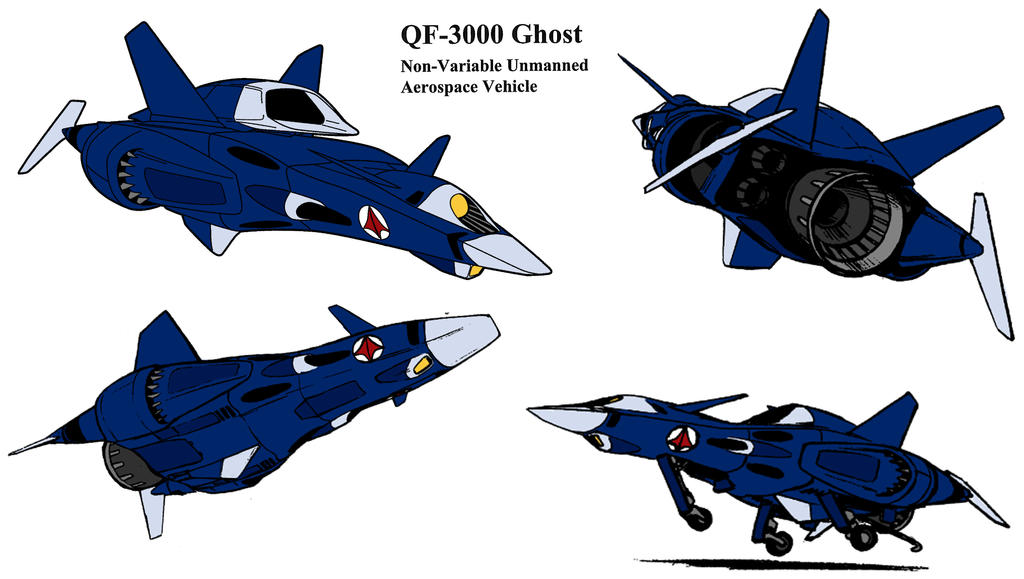
The ID-3,000 Intelligence Drone is the UGC's continuation of the old RDF-Era QF-3,000E Ghost, but with a significant twist; While the QF-series Ghosts were locked into laser cannons for weapons, the ID-3,000 series has any one of several options
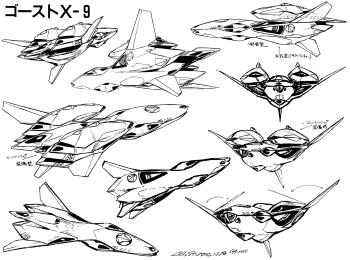
The selection of the Ghost series by the Spacy 500 years ago amounted to needs and availability. The Spacy needed 5,000 units immediately, and were able to recover nearly 25,000 in flight-ready condition at the time. This left the RDF with the option to develop other options as well, and stifled the need for a replacement at the time. It was found that replacing Ghost fighters was infinitely easier, faster, and cheaper than developing a new system that would have to be replaced in time. The ID-3,000 is used extensively by the SPAES in the grav pod configuration; Indeed, every SPAES ship carries one or two, at minimum, when on interdiction duty and usually has one when off interdiction duty. During time of War, fleet-deployed Cutters are equipped with their full complement (usually equal to the number of LRM's). During this time, they typically ride shotgun on the Cutters, protecting them from fire the way the Cutters protect the Spacy vsl Because they do not require a pilot, the ID-3,000 are typically stowed in crates measuring a mere 54 feet×31½ feet×15 feet in stacks of 25 crates. There is an old joke that the Ghost lives in purgatory, until it goes to Hell. That joke is unfortunately true; These drones are rarely used unless combat of some sort IS expected, with the exception of those equipped with interdiction control grav pods (colloquially referred to as "shepherds," the most boring of duties the UGC has) or nav beacons; It's enough to even make the people assigned to go a little batty, making doughnuts and chasing petty wannabe-smugglers, while the real smugglers get through using the wannabe's for cover. They are also used in a wide variety of other missions, such as automated couriers (in fact all official UGC message couriers are Ghosts with the missile pods removed to hold the message/s being couriered), as salvage and recovery drones (mostly with ships), and as automated beacons for AToN. Automated courier drones "can" be equipped with FTL drives but this is not the normal practice; A Ghost arriving with an FTL drive installed (a derivative of the Antran warp drive) is a sign that something very unpleasant awaits her addressee. With increasing message traffic this is becoming less uncommon, but it's still a very expensive upgrade and thus not generally seen. The F/ID-3,000 is the most advanced of the drones series; At approximately half the size of a standard fighter, the Ghost mounts three revolutionary thermonuclear turbine engines and numerous maneuvering verniers that give the fighter incredible speed and agility both in an atmosphere and in space (and the Ghost can be mounted with certain FAST packs for additional thrust if necessary). The armament for the drone is more modest but still impressive, including five pulse lasers and 29 high-maneuverability micro-missiles. In combat the Ghost relies on its speed and maneuverability to conduct hit-and-run attacks on multiple targets, allowing it to often take out entire squadrons before the enemy has a chance to retaliate. But the most impressive feature of the fighter is its onboard AI (artificial intelligence) computer system. The craft can be piloted by remote control from a UGC Station, or can be allowed to operate autonomously in combat. The AI system is quick, clever, and almost savage in the ferocity of its attacks. The system uses an analog-digital hybrid cognitive process, coupled with a 20,000 simulated combat "protocol," which permits the AI both to formulate new plans and strategies on the fly as well as learn during combat to improve its performance. The combination of the Ghost's intelligence, speed, and weaponry make the small drone extremely deadly in combat, able to hold its own against even advanced Veritechs; However, the best drones still are no match for the most basic of biologic capabilities, and therefore have rarely fared well in actual combat except by sheer weight of numbers. With the same number of Guardians versus Veritechs, the Guardian force SHOULD have an 85-90% victory rate at only a 25-30% loss-lead. Because of this, the Ghost has been absolutely rejected by the UGC as a "replacement" for manned fighters, but has been warmly welcomed as an adjunct to them. Research continues at the Macross Consortium, so it may only be a matter of time before a new Ghost fighter is produced that is superior in every way to combat pilots. The Stealthed Ghost can be any color due it's Chameleon System, however when working an intelligence detail it generally goes for a subdued or camouflaging scheme, while in a combat mode generally finds a very BRIGHT, flashy scheme to draw enemy attention (and therefore fire) away from the manned fighter. In common patrol, they go for red for this reason. It should be noted that the F/ID-3,000 Ghost Fighter/Intelligence Drone comes in two main variants; The Blue Unstealthed version whit an airframe dating back the to Terran Global Civil War and saw extensive against the T'sentraedi and in the rebuilding efforts after that war and the wars against the Invid, and the all new Red Stealthed version, an advent midwifed of the Automated Drone program (after the Assault Drone's lack of automated air cover led to questions in the Council). Variants There are a fairly wide array of Ghost variants; The Beacon variant is the most important; The missile systems and five of the lasers are replaced with various antennas and sensors to assist spacers in safely navigating a system and traffic pattern to avoid collisions. These are not unarmed platforms; Though their combat abilities are badly degraded, they can still take warning shots and alert the base stations of a threat. They serve both as nav beacons and as watch and wards, as every ship be she friend or foe entering or exiting the system on an established route (and sometimes outside of those routes) passes by the beacons, thus creating a record of her passage. They are brightly painted and lit red, yellow, or green; As an intra-system route deteriorates the pod will transition from green to yellow and eventually to red; Shortly after going red they will extinguish and transition to their new station. As teh route new stabilizes the pod will light up green. They also have a racon (a radio transmitter that sends out a timestamped message every jiffy, 3×10⁻²⁴ seconds or the time it takes a photon of light to move 1 foot). The diffrence in time between the timestamp and reception time is the distance from the receiver to the beacon. The Courier variant is exactly what it's described as, a basic hull used to transmit messages either too urgent, complex, or sensitive for radio based transmissions. As in the beacon variant the majority of the weapons systems are stripped out, in this case with the open cavity replaced by message canisters and/or message configured MSE-6-Series Repair Droids. The Ghost can carry any type of package but alternatives are very rare. Guard Dog variants are overwise standard Ghost fighters that will ride shotgun to fighters and ships trying to protect their charges in combat. They have been observed to deliberately fly into the path of missiles, but more often will fall in behind their leader to protect their six o'clock position, If a fighter or ship is lost, the surviving Ghosts will attempt to form up with another unit; If there are no responding stations, they're programed to retaliate to exclusion- They become missiles themselves, with no other interest than destroying the aggressor and make them pay for their 'victory.' The Patrol-specific Shepherd variants are used to keep interdiction ball rings intact. Intermittently they will begin retrieving degraded interdiction balls, smelting them down and reprocessing them into ID balls (the applicable equipment replaces the missile pods). They will also very aggressively attempt to intercept ships trying to run the blockade if possible, though they are programmed to treat launches as higher priority than landings. They can also be used to deploy interdiction rings when they've been ordered or withdraw them when the interdiction is lifted, and to open safe passages when needed. Salvage And Repair variants are used to collect material for reprocessing, or to assist in repairs on ships too large to be accommodated in a spacedock (currently the BREETIA TULL-Class Ultra-Dimensional Fortress and SORJOURNER-Class Escort Carriers. They typically operate from OUTLAW-Class Repair And Salvage Ships though exceptions occur (most BREETIA-Class UDF's and SORJOURNER-Class CVE's have a few onboard for their own repairs). The Sentry variant consisting of additional sensors bolted to the frame (mostly the dorsal aspect) standby watching sections of space around a system looking for any ships that attempt to enter outside the standard approach routes. Their programmed to fire a warning shot of twin micro missiles that will detonate at twice the maximum range of the explosion in a very bright flash to gain the ship's attention, then query the vsl as to intentions. Whatever response is retransmitted to the Ghost's base station, including no response at all, but the Ghost will not take further action if the vsl doesn't fire back (they will only track her). Sentries are often left alone in unoccupied systems claimed by the UGC; A Sentry first made contact with the Chigs (it was destroyed; fortunately much cooler heads prevailed quickly). The Strategic Weapons variant is essentially a Ghost with its missile pod removed and replaced with a reflex missile warhead. These are only used on massive targets, space stations and cities, when alternatives are not possible either per the UGC RE/DF Weapons: Mass Destruction/Effect Policy Manual. They are most commonly used in space during invasions to disable or destroy enemy invasion assets (troop and landing ships). Only Strategic Weaps and Courier variant Ghosts were ever upgraded with Cemuh Drives. Name: ID-3,000 Intelligence Drone Model Type: Drone Crew: None! Can be controlled remotely by a pilot or operated autonomously via AI. Passengers: None! In the entire history of the program there have only been three fitted with passengers in statis pods, in all three cases under such urgency that the risk of death outweighed the delay in arrival. However, several thousand have been fitted out as delivery platforms for messaging purposes. Vehicle Type: X-9 Ghost Class: Advanced Unmanned Fighter Drone (Prototype) Manufacturer: Macross Consortium MDC by Location: | |||||||||||||||||||||||||
| * Front Sensor Eye ** Engine Nacelles (2) *** Fuselage Vernier/Weapon Clusters (3) | 15 125 each 200 35 each | Wings (3 or 4, depending on mission profile) FAST Packs (2, optional) | 60 each 75 each | ||||||||||||||||||||||
| Notes: * Destroying the sensor eye of the X-9 will knock out the drone's major sensor systems (including infrared, night vision, and thermal). Radar and communications will be unaffected, but the Ghost will be at -4 to strike. The sensor eye is a very difficult target to hit, however; -5 to strike in addition to velocity penalties. ** Depleting the MDC of one engine nacelle will reduce the Ghost's speed by 40% and give it a -3 penalty to dodge. Depleting the MDC of both nacelles will reduce speed by 80% and impose a -6 penalty to dodge. There is a Third engine in the main body that will enable the Ghost to keep flying even if both nacelles are destroyed, however. *** Depleting the MDC of the main body will disable the Ghost. If controlled by the onboard AI the Ghost will self-destruct to avoid capture by an enemy. Speed and Statistical Data: | |||||||||||||||||||||||||
| Flying: Cruising: Mach 2½; Can cruise at that speed indefinitely. Maximum: Mach 6⅘. On Interdiction Duty: Mach ½ Maximum; The Interdiction Balls can't go any faster, or they fly out of control- Exactly opposite what you want to have happen. Cruising Area: 200,000 mile radius sphere. Can actually operate an indefinite area, but any further than that and it starts to get beyond the reachable area; Otherwise, relays have to be used to maintain comms. Height: 12 feet 10 Width: 21 feet 5 inches. Length: 34½ feet. | Weight: 8½ tons (slightly heavier than the original version). Cargo: One ton of supplies COULD be loaded, but this really ISN'T a cargo craft. Power Plant: RTK-1121 Fusion Pile Reactor (a non-Protoculture reactor, highly radioactive); Lifespan: 20 years. Each powerplant must be removed INTACT after service life termination. Flight System: Grav pods. Thrust System: Tractioning Drive. Cost and Availability:About 100,000€ each; Almost always available. Black Market Cost & Availability: About the same, really; it's not like this is all that tightly regulated. | ||||||||||||||||||||||||
| Weapons Systems: Select a package appropriate to the mission. | |||||||||||||||||||||||||
| 1. Laser Cannons: One or two integral lasers are mounted in banks of two on either side of the drone, while one slightly more powerful one is mounted in the bottom of the aircraft. All five lasers can be fired separately or in combination, against single or multiple targets. The lasers are semi-fixed forward, and can only fire within a 40° arc from the front of the aircraft. This package can be combined with the missile package (option #2) or surveillance package. MD: 3D6 M.D. per side laser, 1D6×10 from lower laser. If all 5 lasers are fired at a single target the combined blast does 3D6×10 M.D. Range: 8,000 feet (2400m). Rate of Fire: The pulse lasers can fire up to 4 blasts per round each (however, bursts are not allowed). The lasers may be fired in any combination at a single target (roll as one blast) or may be fired individually at separate targets. Payload: Unlimited. 2. Self-Destruct Mechanism: The other integral weapon of the F/ID-3,000 is a self-destruct function; It actually works by imploding the main reactor, as opposed to a separate weapons system in and of itself. However, this is a NUCLEAR weapon, and therefore is used only under the most extreme circumstances. They aren't even used to prevent capture- In the event of a possible capture, they'll typically be rammed into a planet or other convenient celestial object. MD: 4D6×100. Blast Area: 20³ mile area. Rate of Fire: One time only. Payload: Just one. 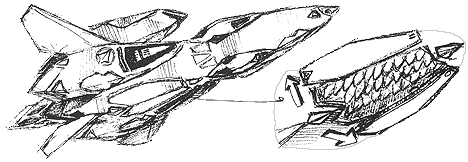 3. Missiles: For additional offensive power, the Ghost can be loaded up with missiles in an underbelly bay between the engine nacelles. When launched, the doors concealing the bay open and the missiles fire downward out of the craft, where they then move to intercept targets either in front of or behind the drone. The missile bay is designed to use the new Bifors BMM-24 all-environment high-maneuverability micro-missiles, but can use any type of Spacy mini-missile if HMMMs are not available. This bay can also hold packages #4, 5, or 6. 3. Missiles: For additional offensive power, the Ghost can be loaded up with missiles in an underbelly bay between the engine nacelles. When launched, the doors concealing the bay open and the missiles fire downward out of the craft, where they then move to intercept targets either in front of or behind the drone. The missile bay is designed to use the new Bifors BMM-24 all-environment high-maneuverability micro-missiles, but can use any type of Spacy mini-missile if HMMMs are not available. This bay can also hold packages #4, 5, or 6.Missile Types: Any standard mini- or short-range missile, including BMM-24 HMMM. BMM-24s are standard issue for the Ghost. Damage and Range: Varies with missile type. Rate of Fire: Can be fired individually or in volleys of any number (2-29) of missiles. If necessary, all 29 missiles can be fired in a single volley. Payload: 30 mini-missiles or 10 SRM's. | 4. Surveillance Package: Any range of standard sensory equipment can be loaded in, but only two or three of them; For example, MRI, Radar, and Thermographic. Effect: 100× the normal the range and sensitivity of the effected sensor. Actions: Up to five WITH THESE SENSORS per melee. Payload: Up to three sensors. 5. Grav Pods: Used to move and corral Interdiction Balls to enforce an interdiction, only available in the unstealth (blue) version. Effect: Simply pulls the balls along and into the proper trajectory. Effect Area: As much as a mile around the craft. Actions per Melee: Up to five WITH THIS SYSTEM. Payload: Unlimited. 6. Bombs: Unpowered versions of the normal mini-missile or SRM Warheads. Damage, Range, and Blast Area: Simply pulls the balls along and into the proper trajectory. Rate of Fire: Up to five WITH THIS SYSTEM. Payload: Triple the normal missile load with SRM or quadruple mini-missiles. 7. Sensor-Jamming FAST Pack: The FAST Pack developed specifically for the Ghost each contain a combination chaff/flare pod that can be used disrupt optical sensors and radar on both missiles and attacking fighters. Game effects: When jettisoned, the pod explodes and releases both chaff and flares, confusing all sensors of enemy craft. Any missiles fired at the Ghost AUTOMATICALLY MISS (regardless of number of missiles) and are lost. In addition, the Ghost AUTOMATICALLY wins initiative and gets to strike first in the following combat round. The Ghost can use the pods at any time during a combat round, even if the drone has lost initiative. Damage: None, other than effects described above. Payload: 2 pods, one per FAST pack.  | ||||||||||||||||||||||||
| Features: | |||||||||||||||||||||||||
The AI computer of the Ghost is not without its faults and problems, however. The computer uses bio-neural circuitry patterned after the human brain, which unfortunately has tendencies for self-preservation and illogical behavior during combat. Any time the Ghost receives over 30 points of damage in a single round, roll on the percentile table below to see if the AI malfunctions. 65-75: The Ghost breaks off combat and retreats at maximum possible speed. 75-85: The Ghost locks onto a single enemy target and tries to destroy it at all costs. It will ignore any other enemy craft (even if attacked by them) and will even try to ram the chosen enemy if it is out of weapons. If the target is destroyed the Ghost will return to normal operation. 85-95: The Ghost goes berserk and attacks any aircraft (militry or civilian) it can detect, regardless of alignment. Controllers at a Spacy base can regain control of the Ghost if they make a successful Computer Operations roll at -20% to skill. 95-00:As above, but the Ghost will no longer respond to remote control signals. The drone will go on a rampage and attack any aircraft it can detect until it is destroyed. (GM's: Yes, it's happened before.) | Missiles are all destroyed. 51-75 Enemy missile or missile volley loses track of real target and veers away in wrong direction (may lock onto another target). 76-00 No effect, missile is still on target. Payload: 60 chaff/flares. Each time the system is engaged, the system fires off 04 chaff/flares. Minimum Effective Distance: 2,910 feet. | ||||||||||||||||||||||||
| Combat Profile For F/ID-3,000 Ghost/X-2: As mentioned above, the X-9 Ghost can operate autonomously or can be directed via remote control from a Spacy base or starship. The stats below represent bonuses for operators trained in remote control operation of the Ghost fighter. In order to have X-9 Ghost combat training the controller must also have the following skills: Computer Operation, Radio: Scrambler, Read Sensory Instruments, Pilot: Jet Fighter (or Pilot: Variable Fighter), and Weapon Systems. Untrained operators attempting to control a Ghost fighter only get bonuses equivalent to Veritech Basic Training. Switching between modes is instantaneous; They're actually on autopilot with a pilot override option, meaning once the pilot gives an order the fighter will obey it, but once they stop giving the order the craft will attempt to return to their original heading and operations. Only when the fighter is slaved to another craft will it continuously accept overrides, changing course to match the leader. Permanent course changes can be put in from any authorized base station. | |||||||||||||||||||||||||
 | |||||||||||||||||||||||||
| 3500 Update: Although only the Strategic Weapons and Courier variants are equipped with Cemuh Drive (their purpose is to travel independently far from the fleet), all variants can be carried to a new station inside of another craft or riding parasite to them. Five Beacon variants can be parasited to an EC-66 (one dorsal and two along each side) to be carried on station (arrive at approximately the correct position, drop the field, release the correct Ghosts, drift away from each other and raise the Cemuh field at about 200-250 away). | |||||||||||||||||||||||||