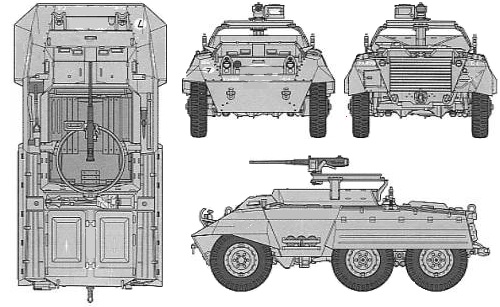


 | Command Armored Car. | | |||
|---|---|---|---|---|---|
| General Discussion The M-558 Galahad Armored Command Car was developed specifically as a command vehicle; Never intended for direct combat, it is meant to control a larger force. However, it does have weapons for
The Galahad has a heavy Autocannon and smoke/flare/chaff dispensers for self-defense; When attacked, the auto-cannon fires mainly for effect, causing attackers to duck for cover, while the dispensers activate to allow the tank to escape. A unique feature of the Galahad is the split-drive arrangement; The generators are in front of the vehicle, while the tractioning drive is in the rear. Along both sides of the hull is a series of batteries that allow the vehicle to run even if the engine is destroyed for a short period of time. This forces an attacker to shoot through the engine, drive, or batteries AND the applicable compartment to even begin rapping on the hull. Only then will the crew compartments begin taking damage, and each crew member is in a SEPARATE compartment, increasing their survivability. Long before the crew compartments are exposed, however, the tank should be escaping. The use of Tractioning Drives, normally reserved for spaceships and some aero-space craft, is also unique to the Galahad. The Galahad rates such equipment due to the needs of the mission (task force or otherwise) to know what is going on around them. They usually use speed and stealth to escape and evade, avoiding direct action. They are often paired with RZ-11 Coastal Defender Radar Arrays, Tonnerre Roulant TELAR, and other related systems. The M-588 are also used for certain support roles, such as high-risk search and rescue, but in the Type IIa variant, in which the majority of the sensors have been removed (to prevent the risk of these falling into enemy hands). Operator Information The M-558 Armored Car is equipped with grav pods, but the general use as a tow vehicle means they are mostly run on their wheels, with the grav pods reserved for evacuation and escape. Strategic Future The utility of the M-558 Armored Car is limited, and the REF has limited their use accordingly; Most of the fleet have been decommissioned entirely, and those still in service are with engineering, repair, and construction units as tow vehicles for near-front line operations. Name: M-558 Galahad Command Armored Car Model Type: Command Class: Armored Car Crew: 3; Pilot/Commander, Force Commander, and Sensor Operator/Gunner. The second title are their secondary job, the First title primary. Passengers: None internally, but up to 5 externally (riding on the hull) is possible but very cramped. This is usually only used to evacuate. MDC By Location: | |||||
| Hull- Crew Compartments (3)- Hatches (3)- Turret- 25ᴍᴍ Auto Cannon- Wheels (6)- | 100 100 each 50 each 50 50 75 each | Searchlights (2, front of hull)- Engine, Battery, and Tractioning Drive Compartments (total of 4)- Engine- Tractioning Drive- Batteries (combined)- | 20 each 100 each 80 70 75 per side. | ||
| Notes: Usual penalties apply. Speed and Statistical Data: | |||||
| Speed: 400 MPH max. NOTE: Due to the use of ultra-powerful grav pods, there is NO physical terrain that they can't traverse, period. NOTE: High surface-water worlds (such as Terra) are known to fit out their armored vehicles with out-board engines, giving some effectiveness on the water; Speed: 30 knots; Range: 200 miles. The grav pods WILL work over water. Hovering Height: From 2 to 200 feet. Hovering Height: Higher flight causes a 02% loss of piloting control per foot (-30% at maximum 15 foot hover height). Maximum Range: 10 years. Height: 4 feet 3½ inches. Width: 4 feet 4½ inches. Length: Hull: 8 feet 4½ inches. Weight: 20 tons. | Power System: MT-842 Fusion Reactor; Output: 221GGw at 21,000 hsp; Lifespan: 10 years. Hover System: Standard grav pods. Drive System: JTR 41 Tractioning Drive; Output: 22,000 hsp. Cargo Capacity: Crew supplies only; A few pounds of various cargos are known to be tied onto the hull, but this is not the true purpose of the tank, and care must be taken to ensure that they do not interfere with the sensor systems. Also, such cargo is subject to any environmental factors (including chemical, biological, and nuclear/Reflex weapons), and should be restricted to crew or critical battlefront supplies only. Cost and Availability: Each tank costs 100,000€; Always available. Black Market Cost and Availability: Between 1,000 and 5M€; Occasionally available. | ||||
| Weapon Systems: | |||||
| 1. 25ᴍᴍ: This turret mounted weapon is meant as an self-defense weapon to escape and evade enemy forces. Uses depleted uranium rounds (which spall and hyper-incinerate on impact). MD: Short Burst: 1D6; Medium Burst: 2D6; Full Melee Burst: 4D6 Blast Radius: 1½ feet Range: 3,200 feet; Utilizing stratospheric gravimetrics, this can be multiplied TEN TIMES, but is -1 strike every other multiple (-5 at maximized range). Rate of Fire: Per Gunner Payload: 4,000 rounds; Can not be reloaded in combat. 2. SRM Launchers (2): The rear of the of the hull has an SRM launcher. They can not rotate nor traverse, and fire vertically only. Primary Purpose: Defense/Anti-Aircraft Secondary Purpose: Offense/Anti-Armor Damage and Range: Varies by type used. Rate Of Fire: Volleys of 1, 2, 3, 4, 6, 12, 18, or all 24 per launcher per pilots attacks per melee. Payload: 24 total. Takes 10 minutes to fully reload per launcher (extra SRM's can be carried inside). 3. M-240: This copula mounted weapon is intended for infantry harassment, effect, and most importantly, for corralling POW's stripped of body armor and weapons. NOTE: This is an SD weapon, not an MD weapon. Also, it is NOT remotely operated, so the commander or the gunner must climb out the copula to operate or re-load the weapon, pull the box out, clear the empty canister, load up the gun, and cycle the gun TWICE; Takes one full melee, and removes the tanks vacuum seal and NBC protection for ten minutes. The weapon is set up with a butterfly trigger grip while mounted, but a standard stock and pistol grip kit is kept on the tank in case it must be abandoned. Damage: 5D6×10 per 10-round burst (only fires bursts). Range: 3,000 feet; Utilizing stratospheric gravimetrics, this can be multiplied TEN TIMES, but is -1 strike every other multiple (-5 at maximized range). Rate of Fire: Payload: 400 rounds per canister; Up to 6 canisters can be carried, but reloading requires the commander to climb out the copula, pull the box out, clear the empty canister, load up the gun, and cycle the gun TWICE; Takes one full melee, and removes the tanks vacuum seal and NBC protection for ten minutes. 4. Variable Full-Force Barrier Field: The Variable Full-Force Barrier Field provides additional protection for the craft. Purpose: Defense. MDC: 200 per panel; 1,200 total available. NOTE: Each panel MUST still have 1 MDC for the system to continue working. Effect: Provides 200 MDC in each of 06 panels. Range: 40 feet. Coverage Characteristics: A full 360° coverage area around the craft. 5. Hardened Circuits: The electronics on board are unaffected by EMPs or scramblers. Purpose: Defense. Effect: EMPs, even military grade ones, have no effect. Ators are known to have such weapons. Range: On board. Coverage Characteristics: All on-board electronics. 6. Decoy Pods: The Steneirian style decoy pods still in use on the Steiner Fighter has been installed on the M-558 under a working agreement with the Steiner Republic. Unlike the pods installed on aero-space craft, however, tankers LOVE the pods. The decoys themselves are specially modified Mini-Missiles that produce burning globs of magnesium/aluminum alloy to confuse both radar AND heat sensory systems, as well as creating a lot of smoke to obscure the tank. NOTE: Though the modified mini-missiles combine smoke flares, AMC/FDs, and LDP's, they aren't powerful enough for use with Destroids & etc. Reduce effects by 20% against smart missiles (add +20% to rolls for smart missiles.) Purpose: Defense. Effect: 01-50: Enemy missile or missile volley detonates in chaff cloud - Missiles are all destroyed. 51-75: Enemy missile or missile volley loses track of real target and veers away in wrong direction (may lock onto another target). 76-00: No effect, missile is still on target. Also note that the chaff cloud will also blind nearby heat sensors (and optically based sensors at night) for 1 melee. They will suffer the following penalties: Reduce melee attacks/actions, and combat bonuses by half. Also, a cloud of smoke approximately 25² feet. Duration: 1D4 melee rounds. Rate of Fire: Once per melee. Payload: 6 chaff/flares. 7. IBM-3600 Combat Computer System: Tracks and identifies specific threats, with a database of over 10,000 objects stored in memory. The computer can detect, identify, and track up to 25,000 targets simultaneously, and keep in active memory up to 30 hours of such information. Feeds information to and takes information from the TIES sub-system. Purpose: Target Identification and Tracking. System Type: Computer; Ties into the TIES. Effect: 70% chance of identifying an unknown object (never before seen) at type and purpose; 78% of identifying a known type variant (such as the Fehran Fighter variant of the Spacer I Space Fighter); 90% of identifying a known type base model (such as the Spacer I Space Fighter). Range: Per Selected Sensor. Minimum Target Characteristic: Per Selected Sensor. Coverage Characteristics: Per Selected Sensor. 8. Hughes USQ-700 Laser Communications Jammer: Designed to detect, analyze, monitor, and jam voice and data laser link signals by enemy forces. NOTE: This is line of sight weapon, and must be aimed PRECISELY at either a transceiver or receiver. Purpose: SIGINTS and communications jamming. System Type: Laser-based. Effect: Can intercept, decode, and jam enemy laser communications. Range: 20,000 miles. Coverage Characteristics: A full 360° coverage area. NOTE: Requires a strike to use at least 3× per melee for full effect at +3 to strike; Each failed roll results in a loss of 33% of the total potential data. Will NOT work against shield-equipped vessels. | 9. Anarrisa Systems Threat Identification and Engagement System (TIES): A sub-system in the IBM-3600 Combat Computer System is TIES; It assists the sensor operators and Mission Commander in identifying targets and selected the proper forces needed for the most effective threat neutralization. The computer then identifies the 300 most threatening targets for the Combat Computer, and assist it in tracking these targets. This system is cable of storing data on the top 900 Identified Targets. It tells the Combat Computer what the target is and what sort of forces should be used on it. Contains all currently known designs, all known major variants, and design characteristics parameters for unknown designs; The system has an 80% unknown design type ID success rate (this reflects chances of identifying an unknown design by type, such as bomber vs. attacker). It also has a 90% ID rate for known designs, and 85% id rate for major variants. Even when the specific variant can not be identified, the basic design USUALLY still can be, and when all else fails it can still at least determine what type of craft the target is. When even this fails, it can read out size, power use, and identifiable weapons systems for the sensor operators. The system also can interface directly with the sensor operators via text readout and synthesized voice system; One such sub-sub-assembly exists for each sensor operator and the Mission Commander; Additionally, they can select data to be shown on their individual displays. Purpose: Target Identification and Threat Assessment. System Type: Threat Identification and Engagement System (TIES) Effect: Knows every major type of threat in the universe, including machines, psionics, magic, and natural occurrences with a minimum of 70%. Range: Per Selected Sensor. Minimum Target Characteristic: Not Applicable. Coverage Characteristics: Per Selected Sensor. 10. Westinghouse RT/SKI-17 Multi-Phase S-Band Phased Array Doppler Surveillance Radar: An advanced multi-phase S-band phased array Doppler-effect based radar array; The system has the capability of scanning in both elevation as well as azimuth and thus can revisit targets; It can simultaneously operate in both low-PRF pulsed modes to enable the detection long-range targets beyond the horizon and high-PRF modes to detect all-altitude targets out to the radar line of sight. However, this is the general viewing/wide angle radar; Not very sensitive, it can still cover large areas for follow up by the SR/AR-225. Purpose: Detection, Identification, and Tracking. Sensor Type: Radar. Effect: Sees all radar-reflective objects within it's coverage sphere. Range: 10,000 miles; However, in space, even this kind of range allows a LOT of area to watch. Minimum Target Characteristic: Anything with a radar-active base; This includes aircraft, ground vehicles, comets, asteroids, and etc. Coverage Characteristics: A sphere of 10,000³ miles. 11. Westinghouse SR/AR-225: Twin electronically-scanned conformal antenna on the sides of the hull. The system views a specific area of about 10² miles at it's maximum range of 10,000 miles much more intensely than the RT/SKI-17, giving it a focused but intense picture of the targeted object. The system can be togged to the RT/SKI-17 for tracking purposes by the operator, preventing an object from moving out of the viewed area. Purpose: Detection, Identification, and Tracking. Sensor Type: Radar Effect: Sees all radar-reflective objects within it's observed area; NOTE: This system can be pinpointed to a given desired area. Range: 10,000 miles. Minimum Target Characteristic: Anything with a radar-active base; This includes aircraft, ground vehicles, comets, asteroids, and etc. Coverage Characteristics: 10,000 miles; NOTE: This system is unidirectional, not omni-directional. 12. STT-K Video Radio Communications Array: Long range, directional communications system with satellite relay capabilities. Purpose: Communications Sensor Type: Radio Effect: Carries video signals. Range: 600 miles, or can be boosted indefinitely via satellite relay. Minimum Target Characteristic: Not Applicable. Coverage Characteristics: A full 360° area. 13. Tourette's TS-42/19 Forward And Side Looking Infra-Red (FLIR/SLIR): Full time forward and side looking infra red system. Mostly used on Search And Rescue missions. Purpose: Infra-red detection. Sensor Type: FLIR/SLIR. Range: 500 miles active, unlimited passive. Minimum Target Characteristic: Any infra-red. Coverage Characteristics: A cone of 360° around the craft, and from 000° aft to 135°. 14. Griger-200RT Active Missile Jamming System: Creates several different fields of false active and misleading signals that missiles then fall into; Enemy missiles may prematurely detonate, or become confused and think they're off-target, when in fact they aren't. Purpose: Anti-Missile Defense. System Type: Active. Effect: 01-50: The missile thinks it's off-course, and will attempt to correct; Re-roll strike at -10. 51-00: The missile thinks it's reached the target and detonates; If it is sufficiently close enough for blast area effect, re-roll as below: 01-45: Missile does no damage. 46-90: Missile does ¼ damage. 91-00: Missile does ½ damage. Range: Begins effective coverage at 100 miles. Minimum Target Characteristic: Missiles. Coverage Characteristics: A full 350° area. 15. Smoke Dispensers (70): This last-ditch system throws out smoke flares capable of covering a 250³ foot area. Special chemicals in the smoke obscures IR and heat sensors, and defeats visual tracking of the vehicle. Note that it DOESN'T make the vehicle invisible, but simply negates ALL bonuses to strike. Purpose: Obscuring the craft for a few moments. System Type: Active Defense. Effect: Creates a cloud of smoke that covers a 250³ foot area. Range: A 250³ foot area. Coverage Characteristics: A full 360°. | ||||
| Features: | |||||
Effects: Silvrite Treated Armor Laser Reflective Armor: All lasers do half damage. Stealth: Limits the tank's radar cross-section, infrared signature, acoustic signature, and other radiation by about 50%. This is increased to 65% when using camouflage nets and other gear. | Effect: 01-50: Enemy missile or missile volley detonates in chaff cloud - Missiles are all destroyed. 51-75: Enemy missile or missile volley loses track of real target and veers away in wrong direction (may lock onto another target). 76-00: No effect, missile is still on target. Also note that the chaff cloud will also blind nearby heat sensors (and optically based sensors at night) for 1 melee. They will suffer the following penalties: Reduce melee attacks/actions, and combat bonuses by half. Also, a cloud of smoke approximately 25³ feet wide and high by about 1 half-mile long. Duration: 1D4 melee rounds. Rate of Fire: Once per melee. Payload: 6 chaff/flares. MDC By Location: Pod: 50 Fiber Optic Cable: 10 Effect: Extends range of any sensors 10× (or defeats other penalties in a 5 mile area). MDC By Location: Pod: 50 Fiber Optic Cable: 10 Effect: Extends range of any sensors 10×. | ||||